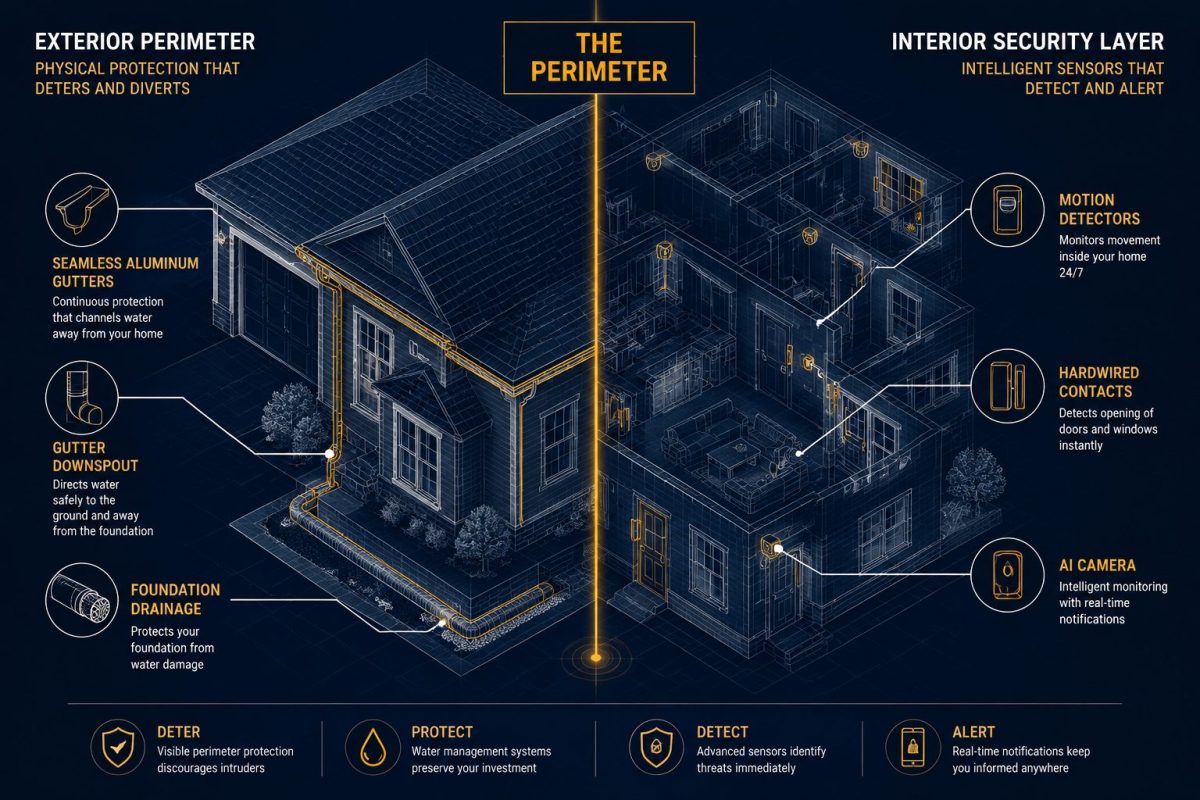
Most homeowners spend real money hardening the outside of their house, new locks, motion lights, fresh gutters, and then leave the interior completely exposed to the next failure point. After 31 years in the trades diagnosing water intrusion and structural drainage failures, I know this pattern well. The perimeter gets attention. What’s inside gets ignored until something breaks.
That same blind spot applies to home security. And in 2026, protecting what’s inside demands the same diagnostic mindset I bring to every guttering job: find the root cause, use the right materials, and build something permanent.
While my crew and I focus on keeping water away from your foundation, I spent my after-hours over the last year solving a different kind of home protection problem.
I realized that most “smart” security systems today are just as flimsy as those plastic sectional gutters you find at the big-box stores. They rely on batteries that die and cloud subscriptions that disappear if the company goes under.
Before we open the Vault, a quick note: I field-test any products mentioned here. As an Amazon Associate, I earn from qualifying purchases at no extra cost to you.
Key Takeaways
- Modern wireless security systems share the same core flaw as cheap gutters: they are built for convenience, not long-term durability
- Hardwired, professional-grade panels like the Honeywell Vista-20P deliver contractor-grade quality without monthly subscription dependency
- Protecting what’s inside requires a layered approach, perimeter detection, interior zones, and local storage
- The same diagnostic approach used in exterior drainage applies directly to security system design
- Subscription-free AI cameras can be integrated with legacy hardwired panels for a best-of-both-worlds build

Why Most “Smart” Security Systems Fail at Protecting What’s Inside
Here is the root cause, stated plainly: consumer security systems are designed around a recurring revenue model, not around your structural safety.
I have diagnosed thousands of drainage failures over my career. The pattern is always the same. A homeowner installs a product that looks good in the store, skips the proper prep work, and ends up with a failure that costs three times more to fix than doing it right the first time would have.
Wireless security systems follow an identical failure pattern.
The three core failure points:
| Failure Point | Root Cause | Real-World Consequence |
|---|---|---|
| Battery-powered sensors | No hardwired power path | Sensors go offline mid-incident |
| Cloud-dependent storage | Third-party server reliance | Footage lost when company folds |
| Subscription-locked features | Revenue model over function | System crippled without monthly fee |
I have watched neighbors lose camera footage during break-ins because their cloud provider had a server outage. That is the equivalent of installing a gutter system with no downspout, the water has nowhere to go when it matters most.
The Subscription Trap
In 2026, the average homeowner pays between $10 and $60 per month for security monitoring or cloud storage. Over ten years, that is up to $7,200 spent on access to your own footage.
A field-tested, hardwired system with local storage eliminates that cost entirely. The upfront investment is higher. The long-term math is not even close.
What “Contractor-Grade Quality” Actually Means in Security
In guttering, contractor-grade quality means seamless aluminum runs, hidden hangers on 16-inch centers, and high-grade sealant at every miter. It means the system works without you thinking about it for the next 20 years.
In security, it means the same thing. Hardwired contacts on every door and window. A professional panel with dedicated zone inputs. Local recording that does not depend on anyone else’s server.
That is the standard I hold my guttering work to. It is the same standard I applied when building my own system.
The Vista-20P Workhorse: A Field-Tested Build for Protecting What’s Inside
The Honeywell Vista-20P has been a workhorse panel in professional security installations for decades. It is not glamorous. It does not have a slick app interface out of the box. What it has is hardwired reliability, expandable zone capacity, and a proven track record in real installations, not marketing demos.
This is the panel I chose for my own build. Here is why.
Why the Vista-20P Earns Its Place
- Hardwired zone inputs: Up to 48 zones with expanders. Every sensor has a dedicated wire path and a dedicated power source.
- No cloud dependency: The panel operates completely independently. If your internet goes down, your security stays up.
- Expandable architecture: Add zones, keypads, or communicators as your needs grow. This is not a closed ecosystem.
- Industry longevity: Parts, programming guides, and installer support are widely available. This panel is not going anywhere.
I have seen homeowners spend $800 on a consumer wireless kit that is obsolete in four years. The Vista-20P is a one-time investment in a platform that has been maintained and supported for over two decades.
Marrying Iron with Silicon
The real-world troubleshooting challenge with the Vista-20P is integration. The panel is built on proven hardwired architecture, the “iron.” Modern AI cameras and local NVR systems are the “silicon.” Getting them to work together cleanly requires the same attention to layout math and material compatibility that I bring to a complex gutter run.
The integration stack I use and recommend:
- Vista-20P panel, the hardwired backbone
- Ademco/Honeywell door and window contacts, hardwired, tamper-resistant
- PIR motion detectors, hardwired, not battery-dependent
- AI-capable IP cameras, local NVR storage, no subscription
- Local NVR with RAID storage, footage stays on your property
This is not a plug-and-play setup. It requires proper layout math for zone assignment, correct wire gauge for run lengths, and careful programming. That is exactly why I documented every step.
The 2026 Home Security Bible
I have documented every step of my own high-security build in my upcoming book: THE VISTA-20P WORKHORSE: The Field Guide to Modernizing Your Honeywell Security System.
It is a 200-page as-built guide for homeowners who want the same thing I give my guttering clients: hardwired, permanent reliability. It covers how to marry the iron of a professional Honeywell system with the silicon of modern AI cameras, completely subscription-free.
“If you are tired of paying monthly fees just to see who is at your front door, you are going to want to read this. Stay tuned to cdavidchase.com for the official release date.”
The Same Diagnostic Approach, Applied to Security
Every guttering job I take starts the same way. I walk the roofline, identify the failure points, trace the water path, and work backward to the root cause. I do not start with solutions. I start with diagnostics.
Home security deserves the same approach.
Step 1: Map your entry points. Every door, every window, every garage entry. These are your zone inputs. Count them before you buy anything.
Step 2: Identify your interior zones. Motion coverage for hallways, living areas, and stairwells. These are your secondary detection layer.
Step 3: Assess your power infrastructure. Where can you run wire? What is your panel location? Do you have a dedicated circuit available?
Step 4: Define your storage strategy. Local NVR, onsite backup, or both. Cloud is an option, not a requirement.
Step 5: Choose your monitoring path. Self-monitoring via app, professional central station, or both. The Vista-20P supports all three.
This is the same five-step diagnostic approach I use before I pull a single piece of aluminum off the truck. Measure twice, cut once. Plan the system before you buy the hardware.
Tool Selection Matters Here Too
You cannot build a permanent foundation with disposable tools. The same principle applies whether you are hanging gutters or pulling wire through a wall cavity.
For the hands-on work in this build, I use an Estwing 16 oz Straight Claw, the same hammer I have trusted for 31 years on the roofline. Before you leave, check out the Contractor’s Toolbox at Guttering.com. You will find the same dependable tools I have dropped from 40 feet in the air and picked back up without a second thought.
Conclusion: Build It Once, Build It Right
After 31 years of field-tested work on residential exteriors, the lesson never changes. Systems built for convenience fail when you need them most. Systems built for structural integrity last decades without drama.
Protecting what’s inside your home in 2026 means making the same commitment to permanence that a properly installed seamless gutter system represents. No disposable batteries. No subscription fees holding your footage hostage. No cloud server standing between you and your own security data.
Your next steps:
- Audit your current system against the five-step diagnostic framework above
- Identify every hardwired versus battery-dependent component you currently have
- Visit cdavidchase.com and get on the notification list for THE VISTA-20P WORKHORSE release
- Check the Contractor’s Toolbox for tools built to the same standard
The perimeter matters. But protecting what’s inside is the whole point.