When most homeowners walk into a big-box hardware store, they are immediately drawn to the 18-volt or 20-volt tool section. The logic is simple: More voltage must mean a better tool. They imagine themselves driving 6-inch deck screws with a driver that looks like it belongs on a construction site.
But after three decades in the gutter business, I can tell you that when you’re 20 feet in the air on a ladder, or tucked into a tight corner fitting a hand-cut miter, a monster driver is your enemy.
My go-to tool for 30 years, the real “hidden hanger” champion of my crew, was the Milwaukee M12 (12-volt) Driver. This is exactly why the Milwaukee 12-Volt Driver beats the 18-Volt Monsters every single time for gutter work. Save your hands, save your budget, and skip the behemoths.
Before we open the contractor’s toolbox, a quick note: I field-test any products mentioned here. As an Amazon Associate, I earn from qualifying purchases at no extra cost to you.
Key Takeaways
- The Milwaukee M12 12-volt driver is lighter, more compact, and better balanced than any 18-volt competitor for roofline work.
- Real-world torque for sinking hidden hanger screws is more than sufficient with the M12, excess voltage causes stripping, not better results.
- Compact size is a safety and precision advantage at height and in tight miter corners.
- Fatigue reduction over a full workday translates directly into cleaner, more accurate installations.
- For gutter-specific tasks, the right tool is the appropriately sized tool, not the most powerful one on the shelf.
The Practical Physics of the Ladder
The primary job of a gutter driver is to sink hidden hanger screws. In my area, this is typically a 1/4-inch self-tapping hex-head screw driven through the gutter and into the fascia board. A lot of homeowners default to a brand like Ryobi or DeWalt in the 18-volt class. The problem is not the power. The problem is the bulk.
An 18-volt driver with a standard battery is a heavy, awkward brick. When you are standing on a 28-foot extension ladder, balancing with one hand and driving a screw straight with the other, every ounce of weight matters. Here is the physics no one talks about in the tool aisle:
- Arm fatigue compounds fast. A driver that weighs 2.5 lbs versus 1.8 lbs does not sound significant. After 80 hanger screws on a 60-foot run, your shoulder knows the difference.
- Off-center weight causes drift. A front-heavy 18-volt driver pulls your wrist off-axis. That means stripped screw heads, angled fasteners, and a compromised seal between the gutter and fascia.
- Ladder balance is non-negotiable. At 20 feet, your free hand is your anchor. A lighter driver means less counterbalance demand on that anchor hand.
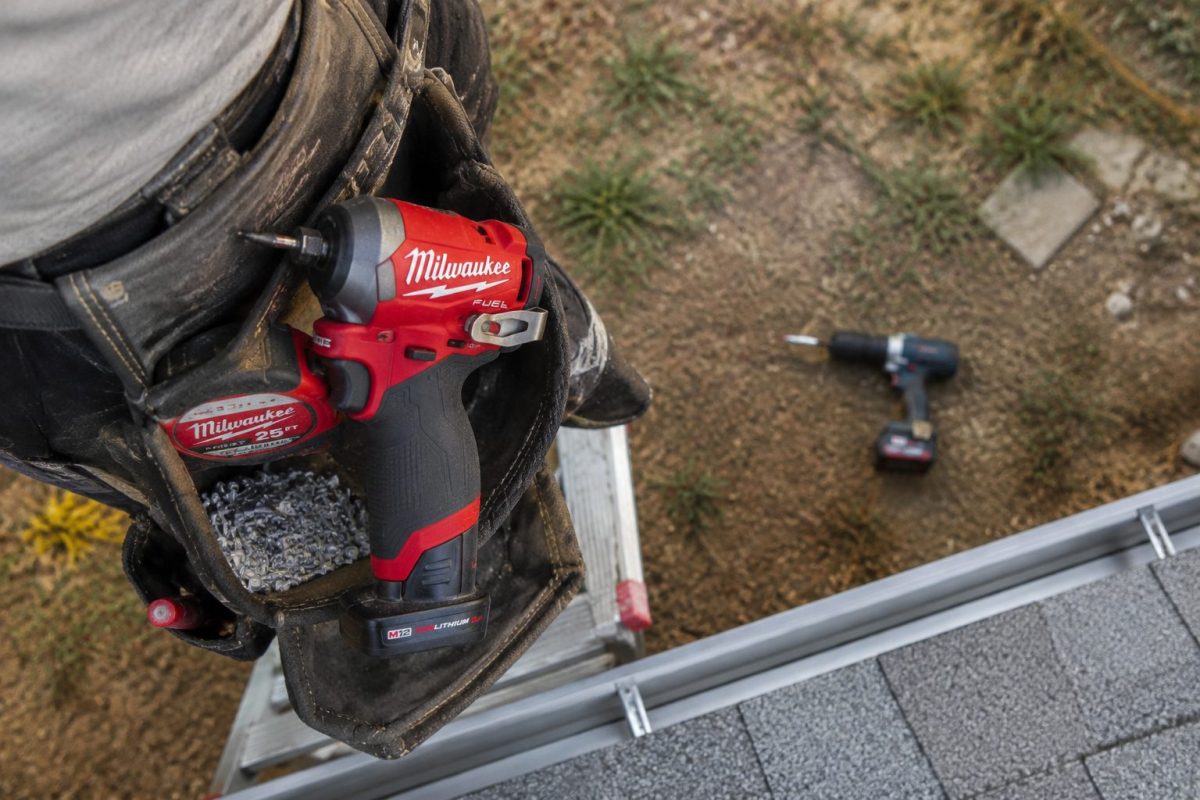
The Milwaukee M12 driver is a different breed. It is light, compact, and perfectly balanced. I can carry it in a standard tool belt all day without fighting it, which means my hand and arm are not fatigued before lunch.
“The right tool is not the most powerful tool. It is the most appropriate tool for the specific task at hand. In 31 years, I have never once wished I had more voltage on a hanger screw.”
Torque vs. Usable Torque
“But David,” you say, “the 18-volt has more torque!”
Maybe on paper. But in my field-tested experience, the M12 delivers as much or more real-world torque for the specific application of sinking hidden hanger screws into a fascia board. Here is why the raw number misleads you:
| Factor | Milwaukee M12 | Typical 18-Volt Driver |
|---|---|---|
| Weight (with battery) | ~1.8 lbs | ~2.8 to 3.5 lbs |
| Torque for 1/4″ hex screw | More than adequate | Excessive, strips easily |
| Head length | Compact, fits tight corners | Long, awkward in miters |
| One-hand control at height | Excellent | Difficult |
| Strip risk on aluminum | Low | High without clutch discipline |
The M12 will drive that hex screw home without breaking a sweat. And it will not strip the head the way an over-powered 18-volt driver does when the clutch is not perfectly dialed in. On aluminum guttering, a stripped screw head is not a minor inconvenience. It is a structural failure point that will leak within two seasons.
The Compact “Miter Master”: Where Milwaukee 12-Volt Driver Beats the 18-Volt Monsters Most
The real beauty of the Milwaukee 12-volt system is not the torque. It is the size.
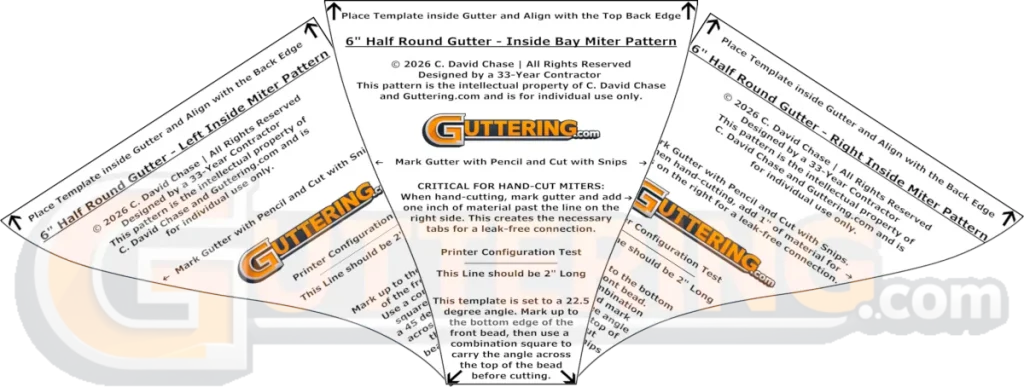
When you are assembling downspouts or fitting hand-cut miters, the precision corner joints that define a truly waterproof installation, you are working in extremely tight, awkward angles. The geometry of an outside corner leaves almost no clearance between the gutter face, the fascia, and the soffit above. Trying to get the tip of a bulky 18-volt driver into the correct position to sink a rivet or a sheet-metal screw in that space is an exercise in frustration.
Here is how I approach a hand-cut miter assembly with the M12:
- Pre-fit the miter dry. Hold both cut sections in position and confirm the joint is tight before any fastener touches metal.
- Mark your screw positions. Two fasteners per miter face, minimum. One high, one low.
- Drive with the M12 one-handed. The compact head clears the soffit overhang cleanly. My other hand holds the metal perfectly in place.
- Seat the screw flush, not countersunk. The M12’s controllable torque makes this easy. An 18-volt driver at full power will dimple the aluminum.
- Apply sealant and close the joint. A clean, tight mechanical connection means the sealant is a backup, not the primary seal.
That one-handed control at step three is everything. It produces the kind of clean, tight seal that defines a professional installation and keeps a foundation dry for decades.
The Final Inspection: Why Milwaukee 12-Volt Driver Beats the 18-Volt Monsters for Every Gutter Job
If you are a professional who makes a living with your tools, you already know the M12 line is a legitimate powerhouse system. If you are a homeowner managing your own gutters, I am going to save you the headache of learning this lesson the hard way on a 24-foot ladder.
The upgrade is simple:
- Ditch the monster driver for roofline work.
- Check Amazons Price on the Milwaukee M12 Fuel 12-Volt driver.
- Stop grunting under unnecessary weight and start installing with the speed, accuracy, and control that builds a truly dry foundation.
The right tool for the job is not always the biggest one. In 31 years of hands-on gutter work, the M12 has been the most-used driver on every single crew I have run. That is not a coincidence. That is field-tested proof.
Conclusion
The case is straightforward. For gutter installation, sinking hidden hangers, assembling downspouts, fitting hand-cut miters, the Milwaukee 12-Volt Driver beats the 18-Volt Monsters on every metric that actually matters at height: weight, balance, one-hand control, and precision torque delivery.
Your next steps are clear:
- Evaluate your current driver. If it weighs more than 2 lbs with the battery, it is working against you on a ladder.
- Pick up the M12. It is the most practical tool investment you can make for exterior drainage work.
- Get the right supporting tools. Don’t fight the metal with gear that was not built for the task.
Shop the Contractor’s Toolbox to pick up the exact professional-offset snips, bits, and hand tools I have trusted for three decades. Get the right gear the first time, save your hands, and do the job like a pro.