If you’ve lived through a Tennessee spring, you already know the Yellow Dust. Between the heavy pollen, the oak tassels, and the maple helicopters, gutters in this region don’t just face rain, they face a sticky, grimy sludge that turns every surface into a biological paste. That’s exactly why most gutter guards fail here, and why the solution most salespeople push is the wrong one for this climate.
I’ve spent 31 years in the trades diagnosing water intrusion problems from the roofline down to the foundation. I’ve pulled off dozens of “professional” hooded gutter systems that were overflowing within one spring season. The problem isn’t always the homeowner’s fault. It’s the product, and the physics behind it.
Before we get into it: I field-test any products mentioned here. As an Amazon Associate, I earn from qualifying purchases at no extra cost to you.
Key Takeaways
- Surface-tension (solid hood) guards rely on water clinging to a curved surface, a mechanism that fails completely when pollen, roof grit, or organic debris coats that surface.
- The “Tennessee Glaze” is the sticky pollen-and-debris film that turns hood guards into water-diversion failures every spring.
- Stainless steel micro-mesh guards use filtration, not surface tension, water goes through the mesh regardless of surface coating.
- The V-bend design in quality micro-mesh guards prevents the sagging and debris pooling that kills cheap screen systems.
- Proper installation, specifically how you handle the drip edge, determines whether even a great product performs or fails.
The Tennessee Glaze: The Root Cause of Why Most Gutter Guards Fail
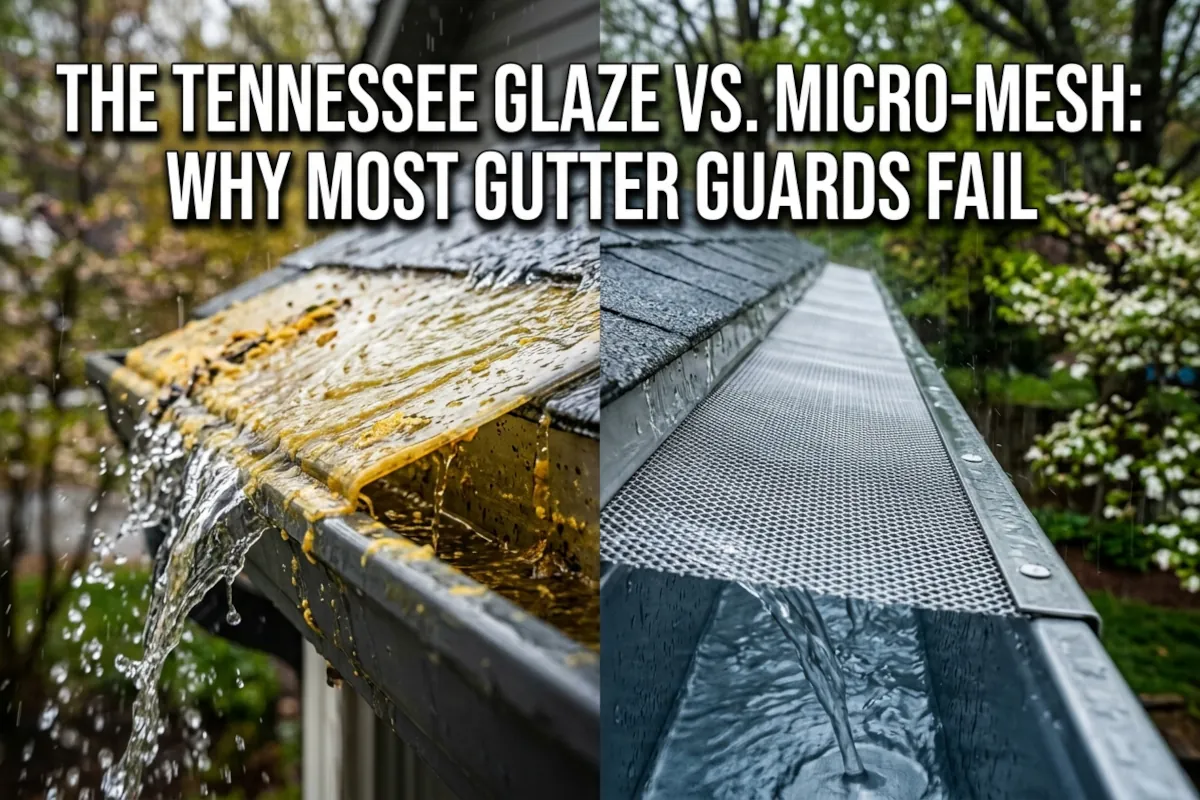
Most homeowners get sold on solid hood guards, the ones that look like a helmet bolted to the top of your gutter. The sales pitch is clean: water clings to the curved hood surface through surface tension, rolls around the lip, and drops into the gutter while leaves fly off the edge. In a controlled lab environment, that works. In a Nashville thunderstorm after three weeks of pollen drop? That’s a different story entirely.
Here’s the diagnostic reality. Surface tension depends on a clean, smooth surface. The moment that hood gets coated with a thin layer of yellow pollen, organic debris, or roof grit, the water no longer clings, it slides. That sticky film acts as a release agent. The water hits the contaminated surface, loses its grip, and sheets right over the gutter entirely.
I call this the Tennessee Glaze. It’s not a one-time event. It happens every spring, every time the oak trees drop their tassels, every time the pine trees release their pollen clouds. The glaze builds up faster than rain can wash it off, and the result is predictable: water dumps directly onto your foundation instead of routing through your downspouts.
“The Tennessee Glaze turns a $5,000 hooded gutter system into a $5,000 waterfall pointed at your foundation.”
This is the core reason why most gutter guards fail in high-pollen, high-organic-debris environments. The failure isn’t random. It’s structural, baked into the physics of surface-tension design.
What Surface Tension Guards Actually Require to Work
To be fair, solid hood guards are not universally bad products. They perform reasonably well when:
- Debris load is low and primarily dry
- The roof pitch keeps organic matter moving quickly
- The homeowner cleans the hood surface two to three times per year
- The regional pollen count is moderate
Tennessee checks none of those boxes reliably. If you’re in a high-pollen region with mature hardwood trees nearby, surface tension is a flawed premise from the start.
The Filter Solution: Why Micro-Mesh Guards Solve the Problem Surface Tension Creates
The fix isn’t a better hood. It’s a completely different approach: filtration instead of surface tension.
A stainless steel micro-mesh guard doesn’t care whether its surface is coated in pollen. Water doesn’t need to cling to anything, it simply passes through the mesh openings by gravity. The debris sits on top of the mesh, dries out between rain events, and the wind or the next heavy rain clears it off. The gutter beneath stays clean and functional.
I’ve been looking closely at the Raptor Gutter Guard system, and it checks the boxes I care about from a contractor’s standpoint.
Why Raptor Micro-Mesh Makes the Cut
1. 304 Stainless Steel Mesh
This is the right material specification. 304 stainless resists rust and corrosion in high-humidity environments, and if you’ve worked a Tennessee summer, you know 90-degree heat with 80% humidity is a material performance test in itself. The mesh openings are fine enough to block roof grit and small pine needles, but the material stays rigid and doesn’t deform under debris load.
2. The V-Bend Structural Design
This detail matters more than most homeowners realize. Cheap flat-screen guards sag over time. That sag creates a low point where debris accumulates, holds moisture, and eventually rots or clogs. The V-bend in the Raptor system keeps the mesh taut across the full span of the gutter opening. A taut surface sheds debris. A sagging surface collects it.
3. Real-World Wet Performance
Unlike a hood guard, the micro-mesh doesn’t need a clean surface to function. Even with a light pollen coating, water still penetrates the mesh openings and drops into the gutter. I’ve tested this in field conditions. It works.
Product Links (Field-Tested):
Check Micro-Mesh current price on Amazon.
- Pro-Grade 5″ Micro-Mesh: Stainless Steel 5″ Micro-Mesh, Ideal for standard 5″ K-style gutters and pine needle environments.
- Pro-Grade 6″ Micro-Mesh: Stainless Steel 6″ Micro-Mesh, For 6″ commercial-grade or oversized residential gutters.
The Contractor’s Warning on Installation
Here’s where I see even good products get undermined: installation errors at the drip edge.
The Raptor system is genuinely DIY-friendly. It ships with self-tapping screws and a magnetic nut driver. That said, I’ll still be reaching for my Milwaukee M12, it’s faster, more consistent torque, and my hands thank me after the third hour on a ladder.
The critical rule: watch your drip edge.
Some installation guides suggest sliding the back edge of the guard up under the first course of shingles. In theory, that creates a clean, sealed connection. In practice, if you’re not careful, you lift the starter strip, break the roofing adhesive seal, and create a new water intrusion point that has nothing to do with gutters.
My preferred method:
- Mount the back edge to the front lip of the gutter or to a drip edge extension
- Keep the guard running parallel to the fascia
- Do not disturb the starter strip or the roofing underlayment seal
- Use the self-tapping screws at consistent 12-inch spacing for a rigid, rattle-free installation
This approach keeps your roof’s waterproofing system intact while still giving the guard a secure, stable mount. Proper water diversion starts with a properly sealed roofline, don’t trade one problem for another.
The Bottom Line on Gutter Guard Failure
Most gutter guards fail because they were designed around ideal conditions that don’t exist in real-world environments. Surface-tension hoods fail the moment organic debris coats their working surface. Cheap flat screens fail the moment they sag and start pooling debris. Neither system was built with the Tennessee Glaze in mind.
Micro-mesh filtration is the contractor’s solution because it doesn’t depend on surface conditions to function. It depends on gravity and mesh openings, two things that don’t change when the pollen count hits 1,500.
Don’t spend $5,000 on a hooded system that overflows during the first heavy thunderstorm of spring. For a fraction of that cost, a properly installed stainless steel micro-mesh system handles real-world debris loads and keeps your drainage working the way it’s supposed to.
Conclusion
After 31 years in the trades, my diagnostic approach to gutter guard failure always comes back to the same question: does this product depend on conditions staying perfect? If the answer is yes, it will fail, because conditions never stay perfect.
Surface-tension guards depend on a clean surface. Tennessee doesn’t give you one. Micro-mesh guards depend on mesh openings and gravity. Those don’t change.
Your next steps:
- Inspect your current guards after the next pollen season. If you see water overshooting the gutter, the Tennessee Glaze has already beaten your system.
- Measure your gutter width, 5″ or 6″, before ordering.
- Install the Raptor micro-mesh to the front gutter lip, not under the shingles.
- Use a proper drill driver (the Milwaukee M12 is my go-to) and space your screws at 12-inch intervals.
Need the right tools for the job? Shop the Contractor’s Toolbox at Guttering.com for the exact rivet guns, bits, drivers, and hand tools I’ve trusted for three decades. Get the right gear the first time, do the job like a pro, and stop fighting your gutters every spring.