After 31 years in the trades, I have watched more than a few hammers fail mid-job. Handles snap. Heads loosen. Cheap steel deforms on the first hard strike against a stubborn fascia nail. The tool you reach for on every job is not a minor decision, it is a direct reflection of how seriously you take the work.
Walk into any big-box hardware store and you will see an entire aisle of hammers. Wooden handles, fiberglass grips, 22-ounce framing “beasts,” and lightweight titanium options that cost more than a cordless drill.
To a DIYer, it looks like a simple choice. To a pro who has spent 30 years with a tool hanging from his hip, it is anything but.
Before we open the contractor’s toolbox, a quick note: I field-test any products mentioned here. As an Amazon Associate, I earn from qualifying purchases at no extra cost to you.
In my toolbox, and hanging on my shop wall, you will only find two things for striking: a 5 lb small sledge for the “heavy persuasion” jobs, and the ESTWING 16 oz Straight Claw Hammer with a Smooth Face. Here is why this one tool has outlasted every other “gimmick” hammer on the market.
Key Takeaways
- The Estwing 16 oz Straight Claw Hammer is built from one solid piece of American-forged steel, no head-to-handle joint means nothing loosens and nothing breaks.
- At 16 ounces, it hits the precision-to-power sweet spot for general contracting, gutter work, and finish tasks without destroying your wrist over a long day.
- The straight (rip) claw doubles as a prying tool, making it genuinely versatile for demo, fascia work, and lumber separation.
- The smooth face protects finished surfaces and eliminates the waffle-pattern damage that milled-face hammers leave behind.
- This is a buy-once, use-for-decades tool, contractor-grade quality at a price that does not require a second mortgage.

The One-Piece Forged Steel Advantage
Most hammers are two pieces, a head stuck onto a handle. That joint is the single biggest failure point in the tool. Over time, those heads loosen. Handles snap under lateral stress. I have seen a hammer head fly off mid-swing on a job site. That is not just an inconvenience; it is a safety incident.
Estwing is famous for their solid steel construction. The head and the handle are one single piece of American-forged steel. There is no joint, no epoxy, no wedge, and no wood grain to split. It is physically impossible for the head to separate because there is no separation point to begin with.
In 31 years of hands-on contracting, I have replaced plenty of tools. I have never replaced an Estwing because of structural failure. That is the kind of material performance that earns a permanent spot in the toolbox.
What “Forged” Actually Means for Material Performance
Forging is not the same as casting. A cast tool is poured into a mold and can have internal voids and inconsistencies. A forged tool is shaped under extreme pressure, which aligns the grain structure of the steel and produces a denser, stronger result.
For a striking tool, that distinction matters enormously. Every hammer blow transfers energy through the steel. A forged head handles that repeated stress cycle far better than a cast alternative. That is why Estwing’s tools carry a lifetime guarantee, the metallurgy backs it up.
Why 16 Ounces Is the Right Call
The “bigger is better” crowd will tell you to grab a 22 or 24-ounce framing hammer. But if you are not framing a whole house, that weight is a one-way ticket to carpal tunnel and fatigue-driven mistakes.
Here is how the weight classes break down in real-world use:
| Hammer Weight | Best Use Case | Drawback |
|---|---|---|
| 12 oz | Finish carpentry, trim work | Not enough force for structural nails |
| 16 oz | General contracting, gutter work, fascia, framing repairs | None, this is the sweet spot |
| 20-22 oz | Production framing, structural work | Heavy for all-day precision tasks |
| 24+ oz | Heavy framing, rough demolition | Fatiguing, imprecise, overkill for most jobs |
The 16 oz sweet spot delivers enough mass to drive a 16d nail in three solid swings, while staying light enough to maintain control during precise work, like setting a fascia nail flush without denting the board.
Estwing’s balance engineering makes this even more effective. The weight distribution on the Estwing 16 oz Straight Claw Hammer is dialed in so the tool feels like an extension of your forearm, not a weight you are fighting against. After a full day on the roof, that balance difference is not subtle. Your elbow and wrist will tell you.
The Straight Claw, the Smooth Face, and the Contractor’s Verdict
The Straight Claw, The “Rip” Claw
I prefer the straight claw over the curved claw, and the reason comes down to field versatility. A curved claw is optimized for one thing: rolling nails out of wood. It does that job fine. But the straight claw does that job AND functions as a prying tool.
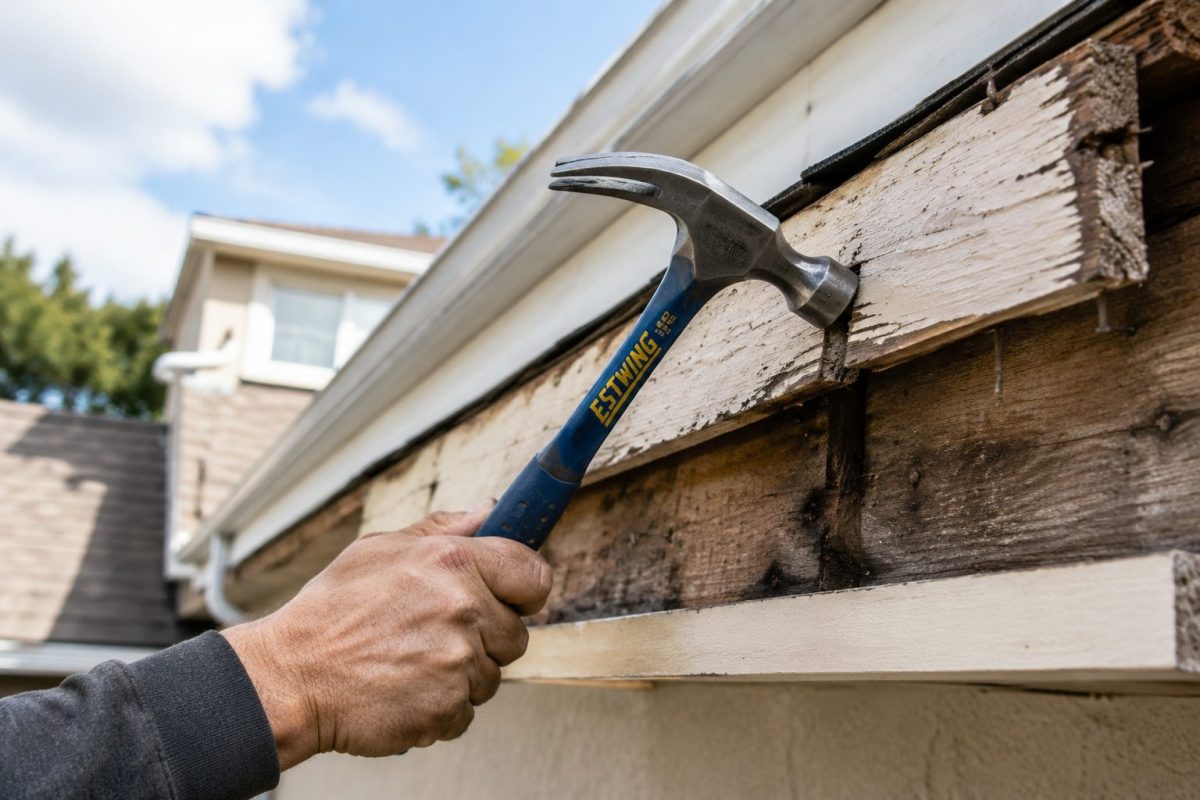
When I am popping off an old fascia board to re-run a gutter line, I need leverage behind the board. A straight claw slides into a gap and gives me a flat prying plane. A curved claw rocks and can split the wood you are trying to save.
- Prying fascia boards away from the sub-fascia without cracking them
- Separating two pieces of lumber that have been nailed face-to-face
- Pulling stubborn ring-shank nails with a direct, linear pull
- Slotting behind aluminum trim to pop it loose without bending
That straight geometry is the reason the rip claw is the preferred choice among experienced tradespeople. It is not a gimmick, it is a functional advantage that shows up on every demo job.
The Smooth Face, Protecting Your Work
For general contracting and any visible surface work, a waffle-head or milled-face hammer is a liability. That textured face is designed to grip nail heads and reduce glancing blows during high-speed production framing. On a job site where you are driving 200 nails an hour into rough lumber, that makes sense.
On a fascia board, a softer trim piece, or any surface a homeowner will actually see? A milled face leaves a checkerboard impression in the wood every time you miss by a quarter inch. The smooth face on the Estwing 16 oz Straight Claw Hammer eliminates that risk entirely.
“The right tool does not just make the job easier, it protects the quality of the result. A smooth face is not a compromise. It is a precision choice.”
It also means this hammer transitions cleanly from rough work to finish work without switching tools. One hammer, full range of tasks.
Shock Absorption, The Blue Grip Matters
One detail that does not get enough attention: the blue leather grip on the Estwing is not just cosmetic. A solid steel handle transmits vibration directly into your hand and wrist. Over an eight-hour day, that adds up to real fatigue and long-term joint stress.
Estwing’s leather grip absorbs a meaningful portion of that vibration. It is not the same as a rubber-dampened fiberglass handle, but it is significantly better than bare steel. For a tool you carry every single day, that difference is felt, not just measured.
The Contractor’s Final Word on the Estwing 16 oz Straight Claw Hammer
I have seen tools come and go over 31 years. Brands get bought out. Quality drops. The “new and improved” version turns out to be cheaper to manufacture and worse to use.
The Estwing has not changed. The blue-grip hammer sitting on my shop wall today is functionally identical to the one I carried on my first big gutter job three decades ago. That consistency is rare. It is the kind of contractor-grade quality you stop having to think about because it never lets you down.
If you are building a serious toolbox, whether you are a homeowner tackling your own exterior work or a tradesperson just starting out, do not get distracted by the fancy gadgets and composite handles. Check Amazon for the current price on the ESTWING 16 oz Straight Claw Hammer with a Smooth Face, use it for 30 years, and then pass it down to someone who will appreciate what a properly built tool feels like.
Is your guttering toolbox empty? If you are going to tackle your own home’s “Foundation Shield,” you cannot depend on bargain-bin tools and “good enough” hardware. In my 31 years on the roof, I have learned that the wrong tool does not just make the job harder, it makes the results fail faster. Do not fight the metal with tools that were not built for the task. Shop the Contractor’s Toolbox to pick up the exact professional crimpers, bits, and hand tools I have trusted for three decades. Get the right gear the first time, save your hands, and do the job like a pro.
Conclusion
The Estwing 16 oz Straight Claw Hammer is not the most exciting purchase you will make for your toolbox. It does not have Bluetooth connectivity or a lithium battery. What it has is 31 years of field-tested reliability, one-piece forged steel construction that physically cannot fail at the handle joint, and a balance that makes an eight-hour day feel manageable.
Here are your actionable next steps:
- If you do not own an Estwing yet, stop borrowing hammers from the back of the truck and pick one up. This is a one-time purchase.
- If you are tackling fascia or gutter work, pair this hammer with proper structural fasteners and a quality sealant, the tool is only as good as the materials it is driving.
- If you are building out your exterior maintenance kit, visit the Contractor’s Toolbox for the full list of hand tools I rely on for residential drainage work.
Buy it once. Use it right. Do the job like a pro.