Half Round vs K Style Gutters: Profile Geometry, Hydraulic Capacity, and Dimensional Specification
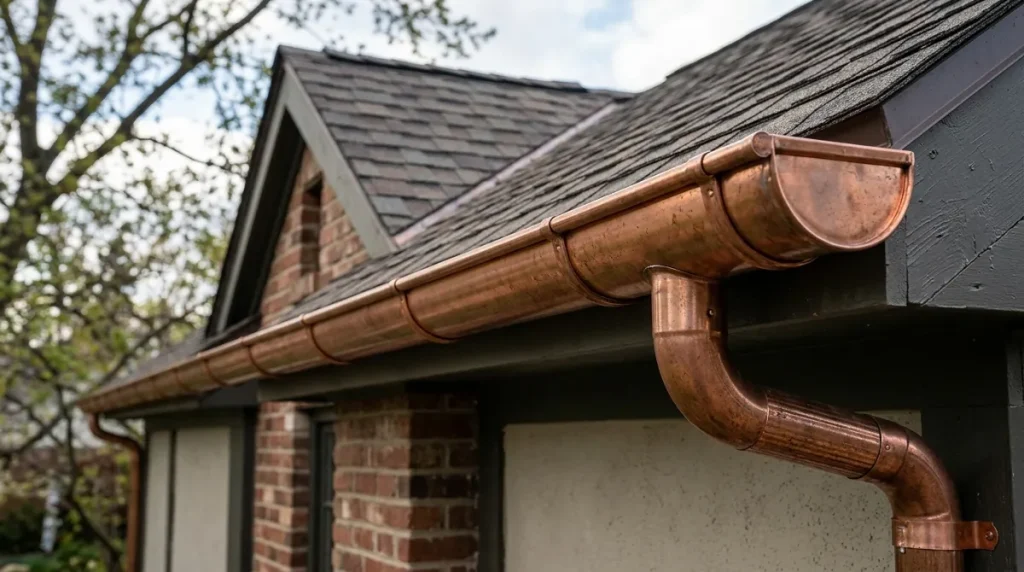
When evaluating half round vs k style gutters, the decision ultimately hinges on understanding how their physical profiles function. What are half round gutters in structural terms: a semicircular open trough profile fabricated from sheet metal — most commonly aluminum, copper, or galvanized steel — with a bead wire rolled into the top lip on both sides to provide structural rigidity and hanger registration geometry.
The half round gutter profile is defined by a true 180-degree arc cross-section, producing a trough shape that is geometrically distinct from the K-style ogee profile in every functional performance dimension: hydraulic flow capacity, debris self-clearance behavior, miter fabrication tolerance, and long-term maintenance access. Per SMACNA Architectural Sheet Metal Manual standards, half round gutter profiles are classified as a primary residential drainage profile with specific hanger, outlet, and miter fabrication requirements distinct from rectangular-profile systems.
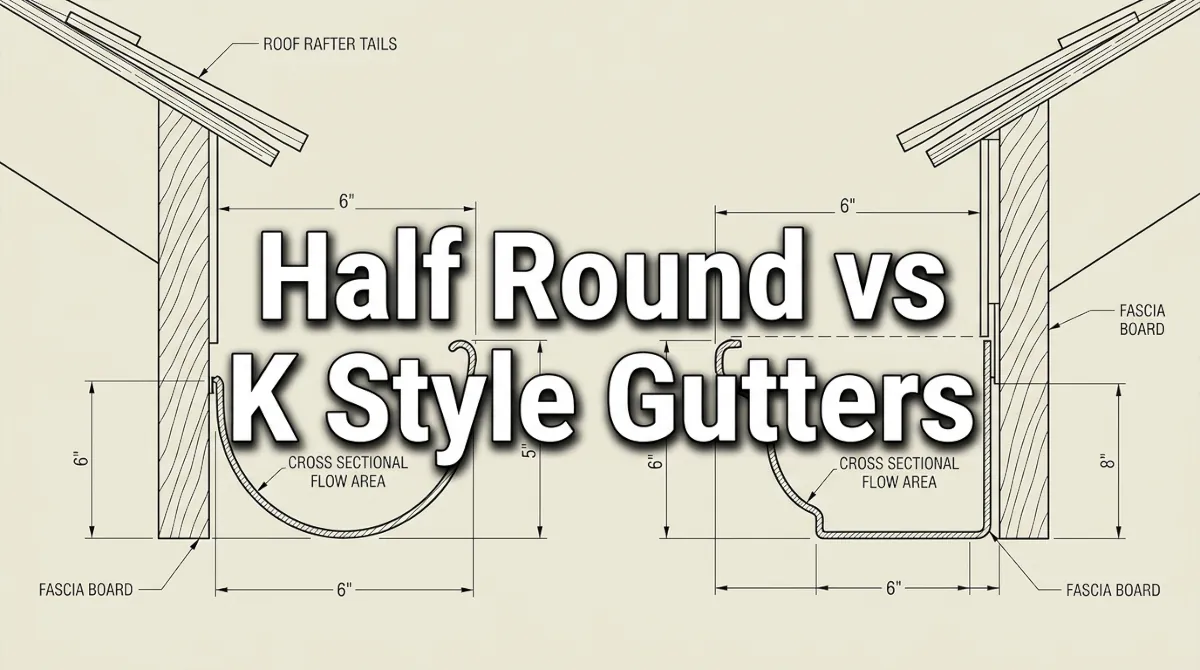
Half Round vs K Style Gutters: Profile Geometry Comparison
The K-style gutter profile has a flat back face, a flat bottom face, and a decorative ogee curve on the front face. The flat back face mounts flush against the fascia board. The flat bottom face provides a rectangular cross-sectional flow area. The ogee front face is a purely aesthetic element with no structural or hydraulic function.
The half round gutter profile has no flat faces. The trough is a continuous semicircular arc from the top lip on one side to the top lip on the other. The absence of flat internal faces is the defining structural characteristic: water and debris move through a curved surface with no internal corners where sediment can accumulate, compact, or initiate biological growth.
| Profile Characteristic | Half Round Gutter | K-Style Gutter |
|---|---|---|
| Cross-section geometry | True semicircular arc — 180° | Rectangular with ogee front face |
| Internal corner count | Zero | Two — bottom-front and bottom-back |
| Fascia mounting method | Bracket hanger or spike-and-ferrule into bead wire | Hidden screw hanger through back face |
| Miter joint type | Fabricated curved miter — no flat face reference | Strip miter or pre-formed corner — flat face reference |
| Downspout connection | Round outlet tube — 3-inch or 4-inch diameter | Rectangular outlet tube — 2×3 or 3×4 |
| Primary application | High-end residential, copper restoration, historical preservation | Production residential, commercial light |
Section 1 — Hydraulic Flow Capacity: Half Round vs K-Style Gutters
Hydraulic flow capacity in an open channel gutter system is determined by the cross-sectional area of the trough, the wetted perimeter, and the Manning roughness coefficient of the trough material. The half round profile and the K-style profile of equivalent nominal width produce different cross-sectional flow areas due to the geometric difference between a semicircular arc and a rectangular channel.
A 6-inch K-style gutter has a nominal cross-sectional flow area of approximately 7.2 square inches, calculated from a trough depth of approximately 3.75 inches and a bottom width of approximately 3.75 inches in a trapezoidal approximation. A 6-inch half round gutter has a cross-sectional flow area of approximately 14.14 square inches, calculated as the area of a semicircle with a 6-inch diameter: π × (3)² ÷ 2 = 14.14 square inches.
| Profile | Nominal Width (in) | Cross-Sectional Flow Area (sq in) | Roof Drainage Capacity (sq ft at 4 in/hr) |
|---|---|---|---|
| K-Style | 5 | ~5.3 | ~5,520 |
| K-Style | 6 | ~7.2 | ~7,960 |
| Half Round | 5 | ~9.82 | ~8,800 |
| Half Round | 6 | ~14.14 | ~11,500 |
The 6-inch half round gutter carries approximately 96 percent more water volume per linear foot than a 6-inch K-style gutter at equivalent pitch and outlet sizing. This hydraulic advantage is a direct function of the semicircular geometry, not material selection or gauge specification. The half round profile is the superior hydraulic choice for high-volume roof drainage applications regardless of material.
Section 2 — Debris Self-Clearance and Maintenance Access
The internal corner geometry of a K-style gutter produces two debris accumulation zones: the bottom-front corner where the ogee face meets the trough floor, and the bottom-back corner where the flat back face meets the trough floor. Shingle grit, pollen, and organic particulate compact in these corners and resist hydraulic flushing at standard flow velocities. Manual removal requires a gutter scoop or high-pressure wand directed at a specific angle to dislodge compacted material from the corner geometry.
The half round gutter trough has no internal corners. The continuous curved surface produces a self-scouring hydraulic action during rainfall events: water velocity increases toward the lowest point of the arc, carrying particulate toward the outlet without corner accumulation. Debris that does not pass through the outlet under hydraulic flow rests on the curved trough floor in a position accessible to a standard gutter scoop without angular repositioning. Maintenance access time per linear foot is measurably lower on half round systems than on equivalent K-style runs.
Section 3 — 5-Inch vs 6-Inch Half Round Gutter: Dimensional Specification
The two standard residential half round gutter sizes are 5-inch and 6-inch, measured across the top opening diameter of the semicircular profile. The dimensional difference between these two sizes affects hydraulic capacity, hanger bracket sizing, outlet tube diameter, and miter template geometry. These four variables are non-interchangeable between sizes.
| Specification Variable | 5-Inch Half Round | 6-Inch Half Round |
|---|---|---|
| Top opening diameter | 5.0 inches | 6.0 inches |
| Trough depth | 2.5 inches | 3.0 inches |
| Cross-sectional flow area | 9.82 sq in | 14.14 sq in |
| Standard outlet tube diameter | 3-inch round | 3-inch or 4-inch round |
| Hanger bracket type | 5-inch half round bracket | 6-inch half round bracket |
| Miter template geometry | 5-inch semicircular arc | 6-inch semicircular arc — not interchangeable |
| Primary application | Standard residential, moderate debris loads | High-end residential, copper restoration, high-volume drainage |
The 6-inch profile is the specified standard for historical restoration work and copper gutter installations on high-end residential structures. The 5-inch profile is appropriate for standard residential applications with roof drainage areas below 8,800 square feet at a 4-inch-per-hour design rainfall intensity. Installations exceeding this threshold require the 6-inch profile or dual-outlet configurations at the 5-inch size.
Section 4 — Material Options for Half Round Gutters
Half round gutters are fabricated in three primary materials for residential applications. Each material produces a different service life expectancy, thermal expansion coefficient, fastener compatibility requirement, and sealant specification.
| Material | Gauge Standard | Service Life (Residential) | Thermal Expansion Coefficient | Sealant Requirement |
|---|---|---|---|---|
| Aluminum | 0.027 inch | 20 – 30 years | 0.0000128 in/in/°F | Tripolymer or polyurethane |
| Copper | 16 oz or 20 oz | 50 – 100 years | 0.0000094 in/in/°F | Lead-free solder or polyurethane |
| Galvanized Steel | 26 gauge | 15 – 25 years | 0.0000065 in/in/°F | Tripolymer — silicone excluded |
Copper half round gutters require soldered miter joints on high-end installations. The soldering process produces a mechanically continuous joint without a sealant bond line subject to thermal cycling delamination. Aluminum half round installations use tripolymer sealant on fabricated miter joints. Silicone sealant is excluded from aluminum half round miter applications due to adhesive failure at the aluminum bond line under thermal cycling conditions within two to three seasonal cycles.
Section 5 — Miter Fabrication Tolerance: Half Round vs K-Style
The half round gutter profile imposes zero tolerance for angular deviation at the miter joint. The K-style profile has two flat faces at the miter — the back face and the bottom face — that can absorb minor scribing errors and still produce a mechanically acceptable joint seat. The half round profile has no flat faces at the miter. A scribing error of one to two degrees produces a compound gap that runs across the full arc of the joint face, requiring excessive sealant to bridge a gap that has no mechanical support.
Precision miter template fabrication is a mandatory requirement for half round gutter installation, not an optional quality upgrade. The miter template must hold the exact angular geometry of the corner and the exact curved profile of the gutter arc simultaneously.
Freehand scribing on a half round miter joint produces compound gap failures at a rate that makes template-based fabrication the only field-viable method for production installation. To eliminate the guesswork and ensure your layout matches this strict geometry on the job site, you can download a printable layout pattern through The Miter Master PDF Kit: 33 Years of Field-Tested Geometry. Using precision architectural templates ensures your cuts align perfectly across the full arc of the joint face, saving you from relying on excessive sealant to bridge structural gaps.
This article follows the field specification established in Fabricate Downspouts Like a Pro — reference that specification for downstream outlet tube sizing, round downspout connection geometry, and strap interval requirements before beginning half round gutter installation.
Installation of half round gutters — whether aluminum, copper, or galvanized steel — requires a specific set of profile-matched brackets, round outlet hole saws, curved miter templates, and tripolymer sealant applicators not used in standard K-style work; the complete professional guttering tools inventory covering every component of the half round fabrication and installation rig is maintained and updated at the Guttering.com tools reference page.