Most homeowners spend between $900 and $3,500 on a gutter guard system and never once ask the installer to prove the product works in heavy rain with pine trees overhead. That is exactly how the industry wants it.
Do gutter guards really work? That is the question every homeowner asks eventually, usually right after a high-pressure salesperson has left their driveway with a signed contract for a $3,000 system, or right after they have pulled a completely clogged guard off their fascia for the third time in two years.
After 31 years of installing, testing, and removing water-shedding systems on residential properties across Tennessee, I have a direct, unfiltered answer to the industry’s most common question: do gutter guards really work?
The short answer is yes, some of them do. But the brutal reality is that most of them fail miserably compared to what the packaging promises. The stark difference between the garbage systems and the true performers comes down to a fundamental law of physics that high-pressure sales companies deliberately sweep under the rug before you sign a check.
Key Takeaways
- Most gutter guard categories fail under real-world debris loads and heavy rainfall, not because of bad luck, but because of flawed physics
- Reverse-curve, foam insert, and flat screen guards each have a specific, predictable failure mode that manufacturers do not advertise
- Stainless steel micro-mesh with an aluminum frame is the only guard category that consistently performs across all four primary debris types
- Correct installation matters as much as product selection, a premium guard installed incorrectly fails immediately
- Before signing any contract, five specific questions will separate legitimate systems from high-pressure sales traps
Do Gutter Guards Really Work, What the Industry Gets Wrong
The gutter guard market is one of the most aggressively marketed product categories in the home improvement industry. In-home sales presentations, lifetime warranties written with enough exclusions to be nearly unenforceable, and performance claims tested under ideal laboratory conditions rather than real debris loads are standard practice across the category.
When a homeowner asks do gutter guards really work, the salesperson answers based on the best-case scenario. I answer based on what I have seen pulled off rooflines after two, five, and ten years of field exposure.
When evaluating whether gutter guards really work, you have to look past the marketing brochures and assess the system’s actual hydraulic capacity. The engineering standards established in the SMACNA Architectural Sheet Metal Manual dictate that roof drainage systems must have unhindered flow and precise sizing to prevent severe water overflow. Defending that structural carrying capacity, and keeping your home’s foundation dry, requires understanding how add-on products alter basic drainage physics before you ever sign a contract.
Here is the honest breakdown by guard category.
Surface Tension Systems, They Fail in Heavy Rain
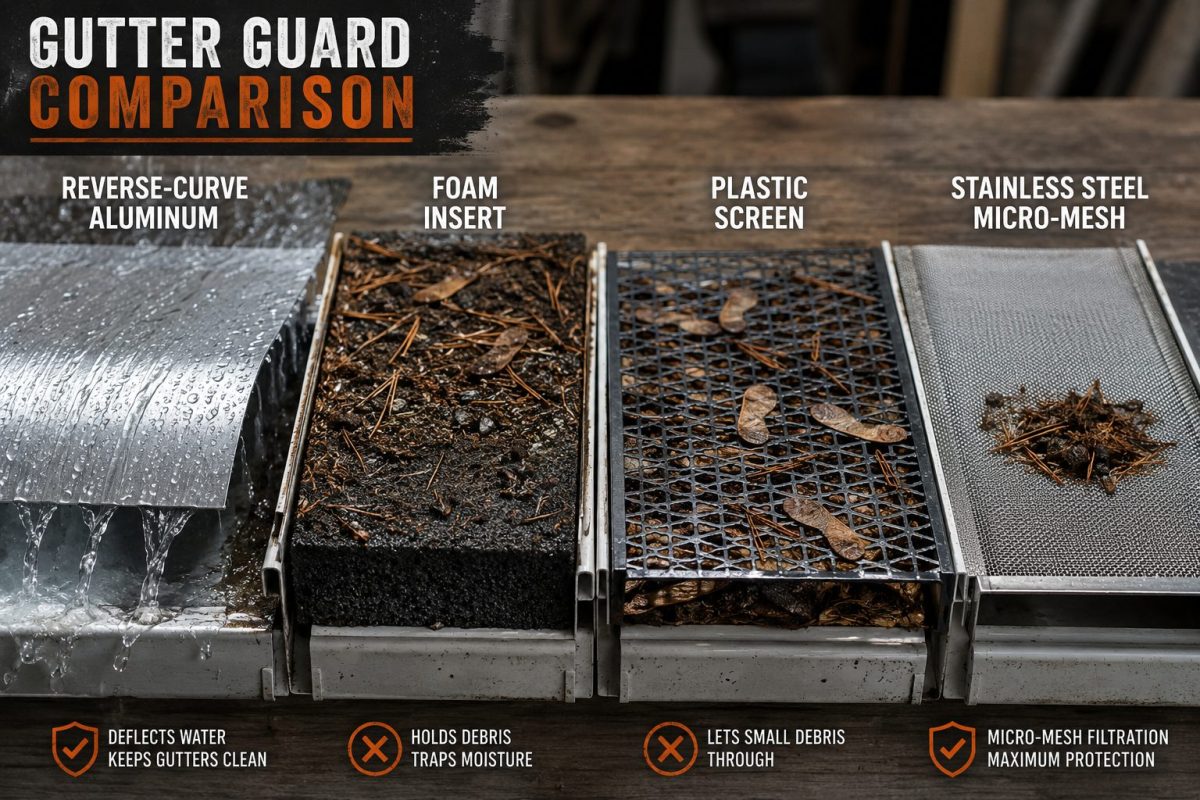
Reverse-curve guards use surface tension to direct water into the gutter while debris theoretically rolls off the edge. They work adequately in light rain with moderate debris loads.
They fail in heavy rainfall events. The volume of water moving across the curved surface exceeds the surface tension capacity. The water overshoots the gutter entirely.
In Tennessee and across the Southeast, where a two-inch-per-hour rainfall event is not unusual, reverse-curve systems routinely dump water directly over the gutter face during the storms that matter most. Do gutter guards of this type really work? Not in the conditions your drainage system was designed to handle.
Foam and Brush Insert Systems, They Trap Debris Inside
Foam blocks and brush inserts sit inside the gutter trough and allow water to pass through the porous material while debris theoretically sits on top.
In practice, debris does not sit on top. It works its way into the foam or brush fibers and compacts there. Within two to three seasons, a foam or brush insert system becomes a debris-packed obstruction that is harder to clean than an open gutter trough.
The guard itself becomes the clog.
When homeowners ask do gutter guards of this type really work, the honest answer is that they create a new problem while claiming to solve the original one. I have pulled foam inserts off fascia boards that were growing moss from the inside out. That is not a drainage solution. That is a maintenance nightmare with a price tag attached.
Flat Screen and Cheap Mesh Systems, They Pass Pine Needles
Flat aluminum or plastic screen guards with large mesh openings stop leaves adequately but pass pine needles, maple seeds, and shingle grit directly through the mesh into the trough.
In areas with significant pine tree coverage, which describes most of the residential Southeast, flat screen guards require the same cleaning frequency as an open gutter, with the added difficulty of removing the guard before the trough can be accessed.
Field Reality CheckFlat screen guards work on the debris type they are not tested against. Leaves? Stopped. Pine needles, shingle grit, maple seeds? Passes straight through. If your property has even one pine tree within 40 feet of the roofline, flat screen guards are a waste of money and installation time.
Stainless Steel Micro-Mesh, The Only Category That Consistently Performs
Stainless steel micro-mesh guards with an aluminum frame are the only guard category I have seen perform consistently across all four primary debris types, leaves, pine needles, maple seeds, and shingle grit, over multiple seasons without structural degradation.
Here is why the material specification matters:
| Guard Type | Stops Leaves | Stops Pine Needles | Heavy Rain Performance | Long-Term Durability |
|---|---|---|---|---|
| Reverse-Curve | Yes | Partial | Fails, overshoots | Moderate |
| Foam Insert | Partial | No, traps inside | Adequate initially | Poor, degrades fast |
| Flat Screen | Yes | No, passes through | Adequate | Low, UV warping |
| Stainless Micro-Mesh | Yes | Yes | Strong, handles volume | High, decade-plus |
The mesh opening is fine enough to stop needle-width debris. The stainless material does not corrode or sag under debris load. The aluminum frame does not warp under UV exposure.
Do gutter guards of this specific type really work? Yes, with two important qualifications:
- They must be installed correctly so the mesh sits flush against the shingle edge
- They must be rinsed periodically to clear fine sediment accumulation from the mesh surface
They reduce cleaning frequency dramatically. They do not eliminate it entirely. Anyone who tells you otherwise is selling you something.
The 5 Questions to Ask Before You Buy Any Guard System
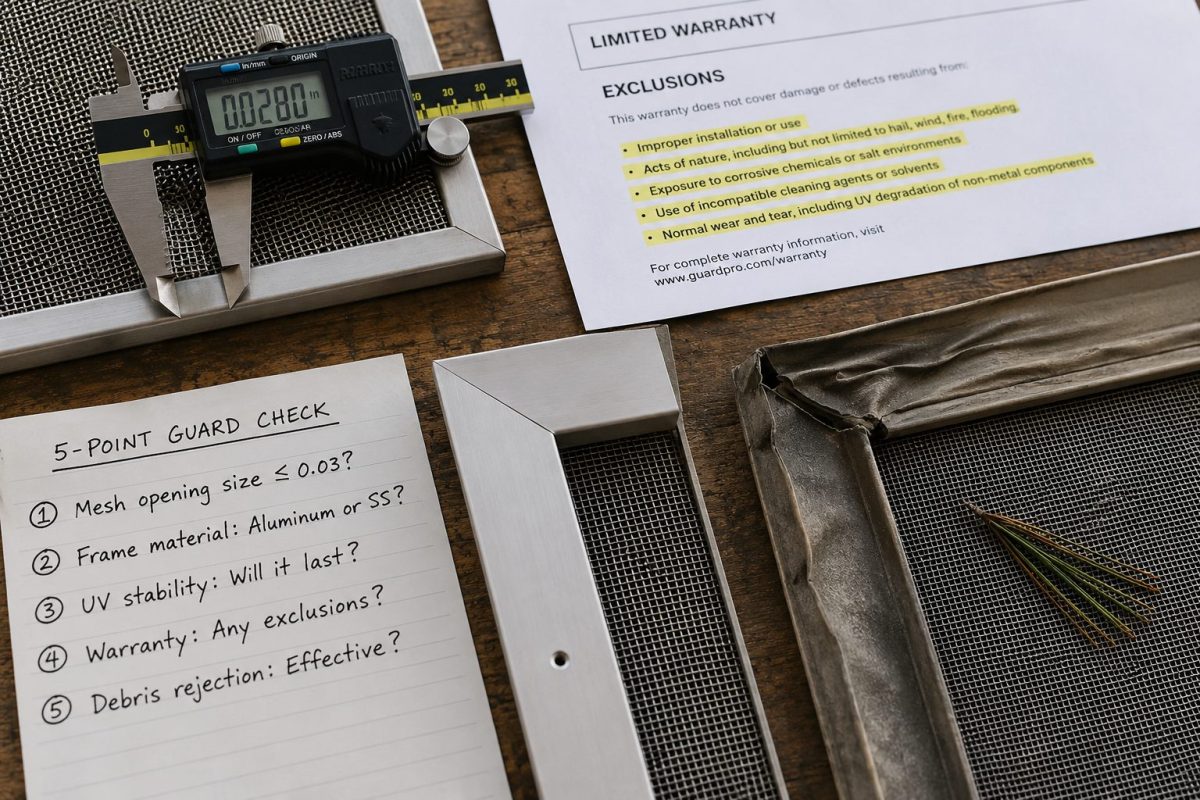
These are the exact questions I would ask if I were a homeowner sitting across from a guard system salesperson. Do not skip a single one.
What is the mesh opening size in microns? A guard marketed as micro-mesh that does not specify the mesh opening size in microns is not a precision product. Legitimate stainless steel micro-mesh guards specify mesh openings of 50 to 150 microns. Vague claims about “fine mesh” are a red flag.
Does installation require lifting the first course of shingles? Any guard that requires sliding tabs under the first shingle course creates a potential water intrusion point at the shingle seal line and may void your roofing manufacturer’s warranty. Verify before signing anything.
What is the warranty exclusion language? Read the full warranty document before purchase. Most lifetime warranty claims exclude damage from debris accumulation, improper installation, and acts of nature, which covers nearly every real-world failure mode.
Is the frame aluminum or plastic? Plastic frames warp under UV exposure within three to five years in direct sun climates. Aluminum frames hold their geometry across decades of thermal cycling. This is a material specification question, not a preference question.
What is the manufacturer’s answer when you ask do gutter guards really work on pine needles specifically? If the answer is vague or redirects to leaf performance, the product has not been tested against the debris type that causes the most problems in forested residential areas.
The Professional Shortcut, 31 Years of Guard Testing in One Resource
Every category breakdown above, every contractor vetting technique, every question to ask before signing a contract, and every failure mode I have documented across 31 years of field work is compiled in one place, written specifically for homeowners who want the insider truth before they spend thousands of dollars on a system that may not perform as advertised.
As an Amazon Associate, I earn from qualifying purchases at no extra cost to you.
Field-Tested Recommendation: Confessions of a Gutter Guard Contractor, written by C. David Chase after 31 years of installing, testing, and removing gutter guard systems on residential properties. This is not a product catalog. It is the contractor’s blueprint: how to vet the installer before they get on your roof, what actually happens to your foundation and fascia when the drainage system fails, and how to maintain your system safely without getting on the ladder yourself. If you want the honest answer to whether gutter guards really work on your specific property and debris load, this is the 31-year shortcut. Available now on Amazon as an instant digital download.
One Final Warning Before You Buy Any Guard System
The most expensive gutter guard mistake is not buying the wrong product. It is buying the right product and having it installed incorrectly.
A stainless steel micro-mesh guard installed with a gap between the mesh edge and the shingle line will pass debris through that gap on every rain event. A guard installed over a gutter that has not been cleaned first traps the existing debris underneath and accelerates the clogging it was supposed to prevent.
The product is only as good as the installation, and the installation is only as good as the installer.
Ask for references from jobs installed three or more years ago, not jobs completed last month. A guard system that is still performing correctly after three Tennessee winters is a guard system that was installed correctly. That is the only field test that counts.
Conclusion
The honest answer to do gutter guards really work is this: it depends entirely on the guard category, the debris load on your specific property, and the quality of the installation. Reverse-curve systems fail in heavy rain. Foam and brush inserts become the clog. Flat screen guards pass the debris that matters most. Stainless steel micro-mesh with an aluminum frame is the one category that holds up across all debris types and all seasons, provided it goes on correctly over a clean trough.
Your next steps:
- Walk your property and identify every tree within 40 feet of your roofline, this tells you your actual debris load
- Pull out any existing guard and inspect the trough beneath it before you buy anything new
- Use the five questions above to screen every contractor and every product before a dollar changes hands
- Head over to the guttering tools page for the complete kit I used in production work for 31 years, every item earned its place through real job site conditions, not a manufacturer spec sheet
As an Amazon Associate, I earn from qualifying purchases at no extra cost to you.